Why Romania Should Be Your Next Travel Destination in 2026
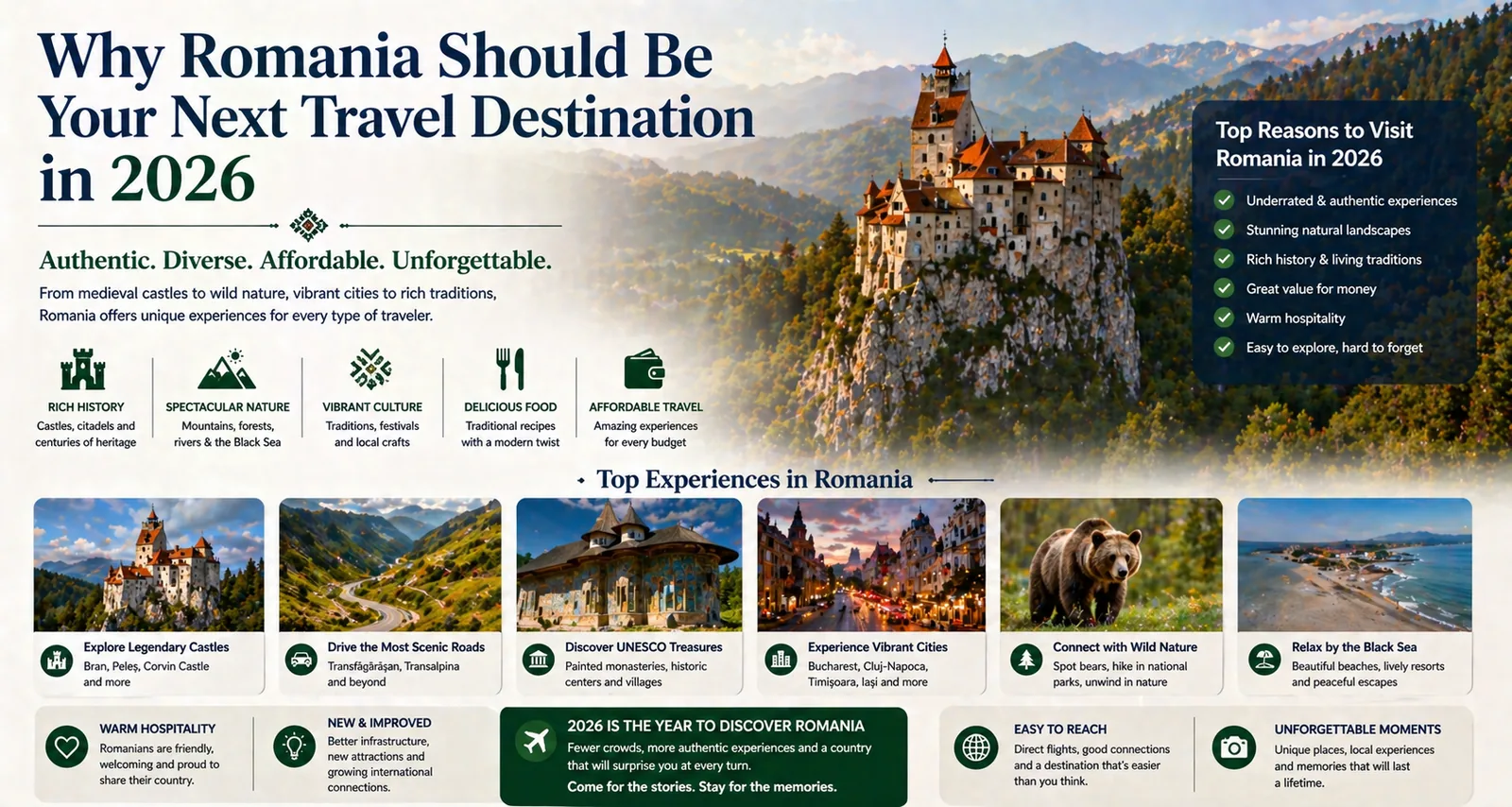
Romania is Europe's best-kept secret — and not for much longer. Medieval cities, UNESCO monasteries, the Danube Delta, bear-watching in the Carpathians and a hospitality culture that hasn't been replaced by tourist infrastructure. Here's why Romania deserves a spot on your travel list in 2026.
Romania keeps appearing on "Europe's hidden gems" lists — and every year it appears a little less hidden. The country has everything that makes a travel destination compelling: history that predates most European capitals, landscapes that haven't been smoothed out for mass tourism, and a food culture that hasn't been replaced by international chains in most of the country.
What Makes Romania Different
The most honest answer: Romania is still real in ways that many European destinations are not. You can walk into a rural market in Maramureș and find farmers selling produce they grew themselves, wearing traditional clothing they use on a daily basis — not for tourists. You can drive through Transylvania and find villages where the pace of life hasn't fundamentally changed in decades. This isn't staged; it's simply how things still are.
The infrastructure has improved considerably in the last decade — roads, accommodation quality and airports have all been upgraded. But the character of the country hasn't been packaged for consumption yet. That window is narrowing.
The Main Reasons to Visit Romania
Transylvania — More Than the Dracula Myth
Transylvania is Bram Stoker's invention overlaid on a real and remarkable place. The actual Transylvania is a region of well-preserved medieval cities (Sibiu, Brașov, Sighișoara, Cluj-Napoca), Saxon villages with fortified churches (Viscri, Biertan, Mălâncrav — several of them UNESCO-listed), and mountain landscapes that range from the Bucegi plateau to the Apuseni caves. Bran Castle does exist and can be visited, but it's one footnote in a much larger story.
The Danube Delta — Europe's Largest Wetland
The Danube Delta is the second-largest river delta in Europe and a UNESCO Biosphere Reserve. It's home to over 300 species of birds — including one of the world's largest breeding colonies of Dalmatian pelicans — and 45 species of freshwater fish. You access it almost entirely by boat, you stay in villages with no road access, and the experience is as close to pure nature as you'll find anywhere on the continent.
The Painted Monasteries of Bucovina
Eight monasteries in the Bucovina region — Voroneț, Sucevița, Moldovița, Humor among them — are covered in exterior frescoes painted in the 16th century. The pigments have survived 500 years of weather; the formula for the famous Voroneț blue remains scientifically unresolved. These aren't local curiosities; they're on the UNESCO World Heritage List for good reason.
The Carpathian Mountains
Romania has one of the largest intact temperate forests in Europe and the highest density of large carnivores on the continent — brown bears, wolves and lynx are all present in significant numbers in the Carpathians. Bear-watching programs in the Brașov area (from observation hides, safely) have become one of Romania's most distinctive tourism products.
The Food
Romanian cuisine is largely unknown internationally — which means discovering it feels like finding something rather than checking a box. Sarmale (stuffed cabbage rolls), mămăligă (polenta served in dozens of ways), ciorbă (sour soups that vary dramatically by region), and the smoked meats of Transylvania and Bucovina are all worth traveling for. Wine production has grown significantly in quality — regions like Dealu Mare, Murfatlar and Cotnari produce wines that now appear on international restaurant lists.
Practical Information for Visiting Romania
Romania is an EU member state — EU and EEA citizens enter without visa requirements. The currency is the Romanian Leu (RON); most tourist areas accept cards, but smaller guesthouses and rural markets operate on cash. English is widely spoken in cities and tourist areas. Driving on Romanian roads has improved considerably, though mountain roads require attention and patience.
Accommodation ranges from budget guesthouses (from €15-20/night) to boutique hotels and restored manor houses (€80-200+/night). AI-Cazare.ro lists exclusively legally-registered accommodation — all properties display their official classification certificate or registration data.
🔍 Cauți cazare verificată în România?
Pe AI-Cazare.ro găsești exclusiv unități autorizate, cu date legale afișate transparent. Rezervă direct la proprietar, fără comisioane ascunse.
Caută cazare acum →Is Romania safe to travel?
Yes. Romania is an EU member state with safety standards comparable to other Eastern European EU countries. Standard travel precautions apply in cities (pickpocketing in crowded areas), but the country doesn't present specific safety concerns for tourists.
What is the best time to visit Romania?
May-June and September-October offer the best combination of weather, landscape and manageable crowds. July-August is peak season — popular destinations will be crowded and more expensive. December is excellent for Christmas markets.
Do I need a car to visit Romania?
For cities (Bucharest, Cluj, Sibiu, Brașov, Timișoara) — no, public transport and ridesharing work well. For the Bucovina monasteries, Maramureș villages, Danube Delta or rural Transylvania — a car is strongly recommended.
Comentarii cititori
Părerea celor care au citit acest articol.